What is Sender Policy Framework?
SPF (Sender Policy Framework) is an email authentication protocol designed to prevent email spoofing and plays a critical role in the DMARC comprehensive security framework.
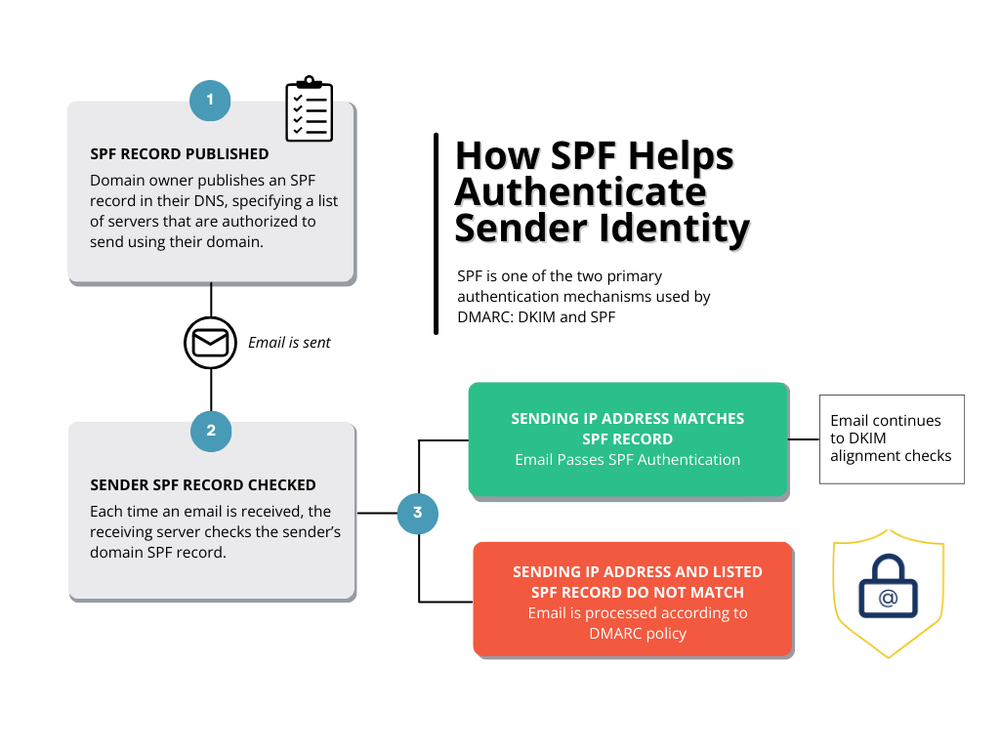
SPF, from the functional daily use standpoint, is a DNS record that allows domain owners to designate approved mail servers for sending emails from their domain.
This designation works to prevent spammers and phishers from using their own mail servers to send out troublesome messages while purporting to be from your domain (both to your users and to your clients and vendors), as anytime an email is received by anyone, their mail server or mail filter will conduct an SPF lookup to see if that email was sent from one of the mail servers specified under the purported sending domain’s SPF record.
If it doesn’t match what the domain record says it should be, it’ll be treated with greater suspicion as being likely spam or a phishing attempt.
The Benefits of Sender Policy Framework
With SPF’s email validation system, your organization can specify which mail servers are authorized to send emails on behalf of your domain, including any mail relay, broadcast or marketing services in use, such as Constant Contact, MailChimp, SendGrid and others.
By having all of your senders authorized, your emails are VASTLY more likely to arrive at their intended destination and not get dropped by receiving mail servers nor marked as spam and quarantined by email filters. Couple that with being an important component of preventing attackers from masquerading as sending emails from your domain and you’ve got a strong bulwark to build the DMARC defenses atop.
Spoofing Protection
Prevent malicious actors from sending unauthorized emails posing as being from your domain - especially to your own users for phishing.
Enhanced Domain Reputation
Signal to potential attackers that your organization is committed to email security and a hard target to try and use for their pernicious plans.
Improved Deliverability
Keep your domain off of blacklists and the resultant email sending failures and bounces.
Weaknesses: Why SPF Alone Isn’t Enough
While SPF is a valuable tool for validating sender identity, it is not a foolproof email security tool in isolation. SPF protection can be bypassed in several ways:
- Spoofing: Overly permissive SPF records that authorize more systems or services than they should, lack of strict enforcement, and misconfiguration may allow for spoofed SPF records to clear validation.
- SPF Lookup Limit: SPF lookups are limited to 10 DNS lookups in order to authenticate the email. If the SPF record requires more than 10 lookups, it may fail delivery or be marked as spam.
- Relay Failures: SPF validation may fail when a message is auto-forwarded or relayed, due to sender IP Changes.
Due to these vulnerabilities, SPF is most effective when deployed as part of a comprehensive DMARC security system. DMARC wraps around SPF and combines it with other supporting services to cover these weaknesses.
How DMARC Works Alongside SPF
When SPF is deployed as part of a layered approach with DMARC, some of the gaps present with SPF alone are mitigated.
- Authentication: SPF serves as one of the two primary authentication mechanisms used by DMARC, alongside DKIM. DKIM is not affected by auto-forwarding or relay, helping maintain authentication even when SPF fails.
- Alignment Check: DMARC enforces an alignment check between the From header domain and domain used for SPF/DKIM authentication, catching cases where an attacker may use a legitimate SPF-passing domain in the MAIL FROM while spoofing an alternative domain in the visible From header.
- Reporting: DMARC Director provides reports on SPF authentication results, helping domain owners monitor the use of their domain.
- Deliverability: Proper SPF configuration as part of DMARC implementation can improve email deliverability rates.
SPF Record Flattening
Ever ran into that situation where you’ve got more than just your mail server sending your messages from your domain? Marketing providers like SendGrid, Constant Contact and more are often used to relay messages out from your domain to better allow for client-identification with the origin of the service your organization provides, even if they are not your mail server.
Getting all of these various services authorized can easily overrun SPF’s 10-record lookup limit (which, if exceeded, invalidates the entire SPF record; a big no-no).
Tangent’s DMARC Director system optimizes your SPF records by condensing multiple SPF mechanisms into a single flattened record. This allows organizations to bypass strict 10-record DNS lookup limitations.
This record flattening has several advantages:
- Avoid strict SPF lookup limitations
- Reduce misconfigurations & complexity in SPF records
- Improve deliverability by making it easier for receiving servers to process your email without having to conduct as many DNS lookups which slows down their deliverability checks.